The Sandal and the Scroll

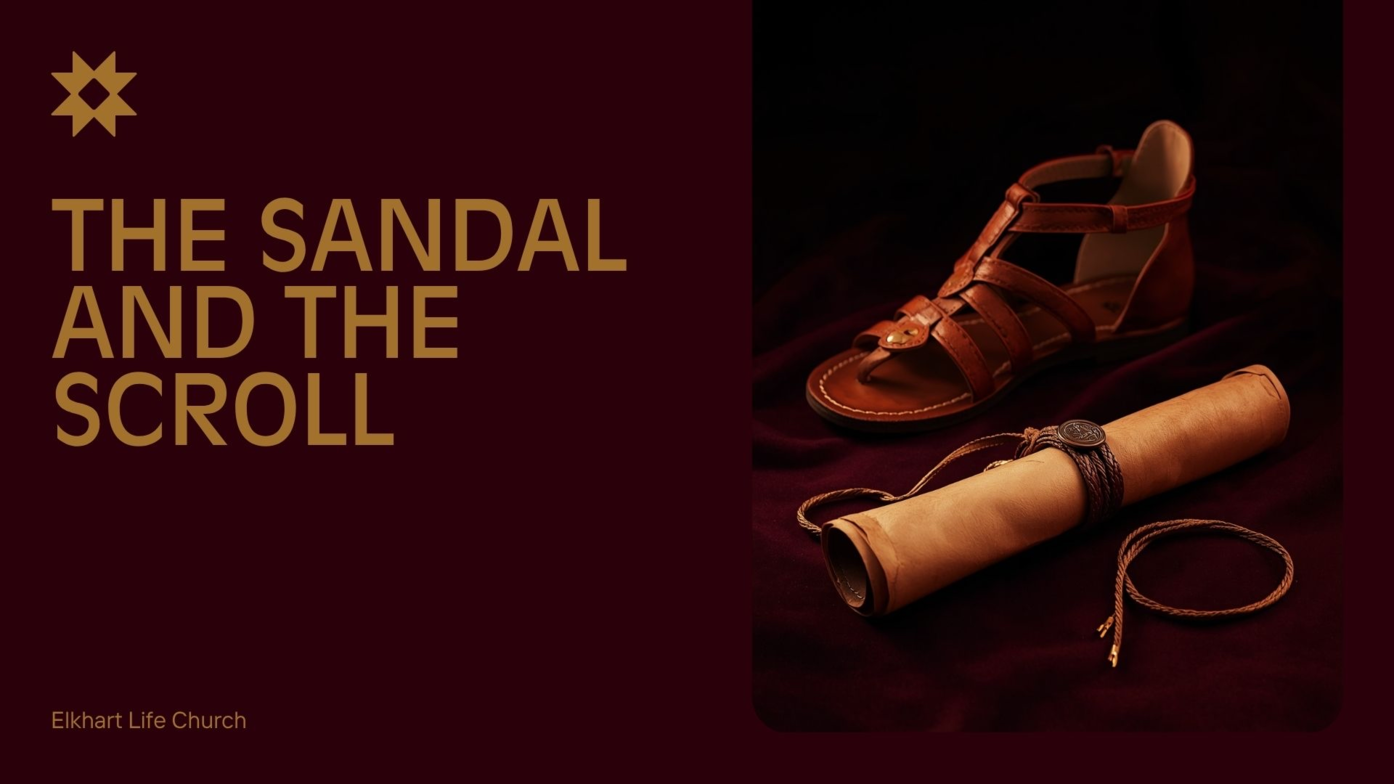
The Sandal and the Scroll: How Jesus Is the Kinsman Redeemer Who Changes Your Future
There is a strange moment in the book of Ruth where a man takes off His sandal and hands it to another person to seal a legal transaction. It sounds odd at first. But this single act connects the Old Testament to the New Testament in a way that reveals exactly who Jesus is and what He came to do for every one of us.
Why the Old Testament Still Matters Today
There is a growing movement in Christianity that tries to separate the New Testament from the Old Testament. Some well-known pastors have even told their congregations that the Old Testament is myth and has no real value for believers today.
But here is the problem with that thinking. The New Testament references the Old Testament over 65,000 times, either through direct quotes or indirect references. You cannot understand who Jesus is without the foundation the Old Testament provides. All of the prophecies about Jesus, His death, His burial, and His resurrection, are rooted in the Old Testament. Pull out that foundation and the whole story falls apart.
Archaeology continues to confirm the historical accuracy of Scripture. The Pool of Siloam, once dismissed by skeptics, was uncovered when workers were fixing a sewer line in Jerusalem. The road Jesus walked from that pool up to the Temple Mount has been excavated and opened to the public. The city of Lachish, mentioned only once in the Bible, was confirmed through a stone pillar carved by a foreign king who recorded his own conquest of that city.
God does not need us to defend His Word. He just needs us to trust it. He will prove Himself in His own time.
What Is a Kinsman Redeemer?
To understand the sandal, you have to understand the law of the kinsman Redeemer.
In ancient Israel, if a family lost their land, their home, or their financial stability through death or hardship, a close relative had the legal right and responsibility to step in and buy back what was lost. This person was called the kinsman Redeemer.
But there were rules. It could not be just anyone. The Redeemer had to share the bloodline. A stranger could not walk up and purchase the land back. Only a kin, someone who shared the family blood, had the authority to redeem what was lost.
This is exactly what plays out in the book of Ruth. Naomi and her daughter-in-law Ruth returned to Bethlehem after losing everything. They were poor, widowed, and without a future. But Boaz, a relative of Naomi, saw Ruth working in his field and recognized his responsibility.
The Story of Ruth, Boaz, and the Sandal
Boaz went to the city gate, the place where legal matters were settled in Israel, and waited for a closer relative to arrive. When the man showed up, Boaz laid out the situation. There was land to be redeemed and a widow to be cared for.
The closer relative was initially interested until he heard the full terms. He would have to marry Ruth, and any children born from that marriage would not carry his name. They would be counted as the children of Ruth's deceased husband. The inheritance would not go to him. It would go to a family that was not his own.
He backed out. And when he did, he took off his sandal and handed it to Boaz. That act was the legal declaration. It meant: I am giving up my right. Someone else has the authority now.
Boaz accepted the sandal. He accepted the responsibility. He paid the price, took Ruth as his wife, and committed to producing a future for a family that had no future left.
Why Did John the Baptist Say He Was Not Worthy to Unlatch Jesus' Sandal?
John the Baptist was a priest's son. He grew up around the temple. He would have read the book of Ruth many times. He knew the law of the kinsman Redeemer. He understood exactly what the sandal meant.
So when John stood in the wilderness and declared that one was coming after him whose sandal latchet he was not worthy to unlatch, he was not just being humble. He was making a theological statement rooted in the Old Testament law.
He was saying: I do not have the bloodline. I do not have the authority. I am not the kinsman Redeemer. I cannot pay the price. I cannot open what needs to be opened. Someone else has to do that.
The Scroll in Revelation and the Only One Worthy to Open It
Fast forward to the book of Revelation, chapter five. John is in heaven and a scroll is presented. All of heaven is gathered. Angels, elders, every power in existence is present. And the cry goes out: who is worthy to open the scroll?
No one steps forward. No one qualifies. The word used in the original Greek for the seal on that scroll is the same word John used when he said he was not worthy to unlatch the sandal of Jesus. The scroll is sealed with a cord, and to open it requires someone with the authority of a kinsman Redeemer.
None of the angels share our blood. None of the heavenly beings are kin to mankind. No one in that room has the authority to step forward and open what has been sealed.
Then the announcement comes:
"But one of the elders said to me, 'Do not weep. Behold, the Lion of the tribe of Judah, the Root of David, has prevailed to open the scroll and to loose its seven seals.'" - Revelation 5:5 New King James Version (NKJV)
You expect a lion to walk out. Powerful. Commanding. Unstoppable. Instead, John turns and sees a lamb that had been slain.
Why Is the Lion of Judah Also the Lamb That Was Slain?
This is where everything comes together. The only one in all of heaven and earth with the authority to open the scroll, to act as kinsman Redeemer for all of mankind, is the one who took on human flesh and shared our blood.
When Jesus shed His blood on the cross, He was not just dying. He was qualifying Himself. He became kin to us. He shared our nature. And because He shared our blood, He had the legal authority in heaven to step forward and say: I am the kinsman Redeemer. I will pay the price. I will open what has been sealed. I will produce a future for a family that had no future left.
"And they sang a new song, saying: 'You are worthy to take the scroll, and to open its seals; for You were slain, and have redeemed us to God by Your blood out of every tribe and tongue and people and nation.'" - Revelation 5:9 New King James Version (NKJV)
This is also why, on the night before His crucifixion, Jesus knelt down and unlatched the sandals of His disciples to wash their feet. Peter resisted. Jesus told him plainly:
"Jesus answered and said to Him, 'What I am doing you do not understand now, but you will know after this.'" - John 13:7 New King James Version (NKJV)
The weight of that moment carries all the way from the book of Ruth to the throne room of heaven. Jesus was demonstrating His role. He was the one with the authority to unlatch. He was the kinsman Redeemer, and He was about to pay the price.
What This Means for Your Life Right Now
God has a plan for your life that was written before you were born. Standing in the middle of your story, you cannot see the end of the book. But the one who bled for you and died for you is also the one writing your tomorrow.
Your future is not written by your enemy. It is not determined by your past mistakes or your current struggles. It is held in the hands of the one who qualified Himself through His own blood to be your Redeemer.
Even in a dead situation, God says there is life. Even when the family line looks finished, God says He will produce a future. That is what He did for Ruth and Naomi. That is what He does for every person who trusts Him.
Faith over fear. That is the choice in front of every believer. Not because the battle is not real, but because the one fighting for you is greater than anything standing against you.
"Then Peter said to them, 'Repent, and let every one of you be baptized in the name of Jesus Christ for the remission of sins; and you shall receive the gift of the Holy Spirit.'" - Acts 2:38 New King James Version (NKJV)
The blood of the Lamb is applied to our lives through repentance and baptism in His name. That is how the kinsman Redeemer's work becomes personal. That is how the scroll gets opened in your life.
Life Application
This week, identify one area of your life where you have been painting the future black, where fear has been louder than faith. Write it down. Then intentionally surrender that specific thing to God and declare out loud that your tomorrow belongs to Him, not to your circumstances or your enemy.
Ask yourself these questions as you reflect on this message:
- Am I trusting God with my future, or am I trying to write my own story based on what I can see right now?
- Do I truly believe that Jesus, as my kinsman Redeemer, has already paid the price for my redemption and has the authority to open doors in my life that no one else can open?
- Is there a situation in my life where I need to stop mourning what has been lost and start believing that God can produce something new?
- How deeply am I building my faith on the full Word of God, both Old and New Testament, so that my foundation cannot be shaken?
The end of your story, when written by God, is going to be absolutely fantastic. Keep the faith. He is your kinsman Redeemer, and He is not finished yet.