Fruit that creates character

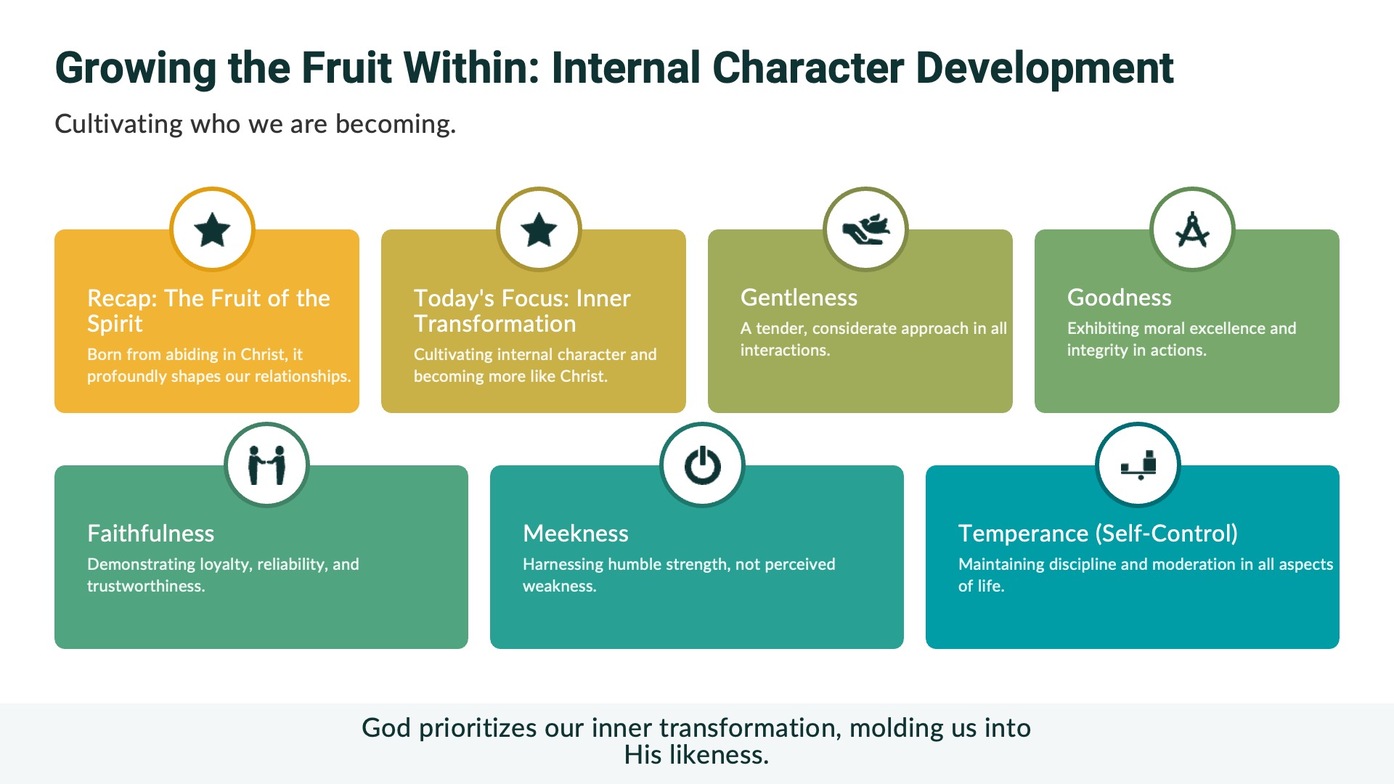
Building Character from the Inside Out: The Inner Fruits of the Spirit
Character development is one of the most challenging aspects of Christian living. While we often focus on external behaviors and relationships, true transformation begins in the heart. The fruits of the Spirit aren't just about how we treat others - they're about who we become on the inside.
Why Internal Character Matters More Than External Approval
It's tempting to think that displaying the fruits of the Spirit will automatically make everyone like us. But this isn't biblical. Jesus himself was perfect, yet people hated him enough to crucify him. The goal isn't universal approval - it's internal transformation that reflects God's character.
Out of the abundance of the heart, the mouth speaks. You can't fake what's in your heart for long. The only way to change what comes out of your mouth is to change what's in your heart. This is why God prioritizes discipleship over crusades or outreach events - He's more concerned with making disciples than drawing crowds.
What Does Gentleness Really Look Like?
Gentleness isn't weakness - it's strength under control. Think of a powerful gorilla gently touching the face of someone he loves. The gorilla has massive strength but chooses to express it with incredible care and restraint.
Jesus demonstrated this perfectly. He had the power to call down ten thousand angels, yet he allowed himself to be beaten, mocked, and crucified. He calmed storms and cast out demons, but he also allowed sinners to approach him without condemnation.
Gentleness Doesn't Mean Agreeing with Everything
Our society pressures us to avoid offending anyone, but being gentle doesn't mean compromising truth. When someone has a problem, you don't have to make their problem your problem. You can disagree without being a bully, and you can stand for truth without being offensive.
The gospel itself is offensive to some people. The claim that Jesus is the only way to heaven offends those who believe all roads lead to God. But we shouldn't try to make the gospel inoffensive - we should present it with gentleness while maintaining its truth.
Understanding True Goodness and Moral Integrity
Goodness means moral excellence based on God's standards, not society's shifting values. Without God as our foundation, we end up with moral relativism - the idea that right and wrong depend on circumstances.
The Problem with Moral Relativism
Imagine a football game where the goal posts could be moved based on circumstances. Everyone would be outraged because games need fixed rules to function. Yet our society wants moral relativism in everything else.
When a Supreme Court Justice can't define what a woman is, we've reached peak moral relativism. Basic biological realities become "relative" when we abandon God's standards. This leads to chaos and confusion in every area of life.
Joseph's Example of Moral Integrity
When Potiphar's wife tried to seduce Joseph, he didn't entertain the temptation or wonder if it might be okay. He immediately recognized it as sin against God and fled. He viewed moral compromise not as a personal choice, but as rebellion against God himself.
Why Young People Need to Reject Society's Lies
Young people today are bombarded with messages designed to create fear and chaos. They're told not to have children because the world is terrible, resources are scarce, and the future is hopeless. These are lies.
The world has more resources and food than ever before. We throw away more food than previous generations ever had. God's command to "go forth and multiply" still applies. Don't let fear-mongering prevent you from experiencing the blessings of marriage and family.
The Importance of Long-term Thinking
Young people often struggle with self-control because their brains aren't fully developed for long-term thinking. They focus on immediate fun without considering future consequences.
But character requires looking far ahead, like a farmer plowing straight rows by aiming at a distant tree. Decide now that you want to live for God when you're 70 or 80. Don't wait for circumstances to force that decision.
What Faithfulness Looks Like in Practice
Faithfulness means consistent loyalty regardless of external pressures. Daniel continued praying toward Jerusalem even when it was illegal and the temple was destroyed. He had no physical evidence that God's promises would be fulfilled, but he remained faithful to what he knew was true.
The three Hebrew boys refused to bow to the king's image even though it meant death. They didn't know God would send a fourth man into the fire - they were prepared to die for their convictions.
Faithfulness Requires Rejecting False Doctrines
Every generation faces new false teachings that sound appealing. Some claim there's no hell, or that your spirit is saved while your body can sin freely. These doctrines always lead to destruction because they contradict God's word.
If it's not biblical, it's not true. Don't be blown about by every wind of doctrine, no matter how appealing it sounds.
Meekness: Humble Strength Before God
Meekness is humility before God regardless of how strong or powerful you are. Moses was called the meekest man on earth, yet he led an entire nation and performed mighty miracles. Meekness recognizes that God is the source of all strength and ability.
The Challenge of Self-Control
Temperance or self-control can be especially difficult for young people who naturally focus on immediate gratification. The Bible compares someone without self-control to a city with broken walls - completely vulnerable to attack.
Self-control means not overdoing anything - not being overly angry, not overindulging, not overreacting. It requires holding yourself back and thinking about long-term consequences rather than immediate pleasure.
The Cost of Foolish Fun
There's a difference between good clean fun and foolish fun that can have devastating consequences. Racing cars at 110 mph might seem exciting in the moment, but it can destroy lives in an instant.
Young people need to understand that some forms of "fun" carry costs they can't imagine. The temporary pleasure isn't worth the potential lifetime of consequences.
Life Application
This week, choose one area of internal character to focus on. Whether it's gentleness, goodness, faithfulness, meekness, or self-control, commit to letting God transform you from the inside out. Remember that character development is a long-term process that requires looking far ahead rather than focusing on immediate circumstances.
Ask yourself these questions:
- What does my heart reveal when I'm under pressure or facing conflict?
- Am I basing my moral decisions on God's word or on society's shifting standards?
- Where do I need to exercise more self-control in my daily life?
- Am I prepared to remain faithful to God even when it's difficult or unpopular?
Character isn't built overnight, but every choice you make either moves you toward or away from the person God wants you to become. Choose to aim for the distant goal of living faithfully for God throughout your entire life, and let that vision guide your daily decisions.