Streams in the Desert

When the Mountain Feels Bigger Than Your God: Lessons from Hezekiah on Faith, Fear, and Trusting God
Life has a way of surrounding us with problems that feel too big to overcome. But what does the Bible say about facing those moments? The story of Hezekiah offers a powerful and honest look at what it means to trust God when the enemy is at the gate and the mountain looks impossible to move.
Even the Most Faithful People Face Storms
Second Kings 18:5 describes Hezekiah as one of the greatest kings in all of Judah's history. The scripture says:
"He trusted in the Lord God of Israel, so that after him was none like him among all the kings of Judah, nor any that were before Him." - 2 Kings 18:5 New King James Version (NKJV)
That is a remarkable statement. No king before or after him trusted God as deeply as Hezekiah did. And yet, just a few verses later, Sennacherib, king of Assyria, came against all the fortified cities of Judah and took them.
Faithfulness does not exempt you from storms. Even the most devoted believer will face seasons of pressure, attack, and fear.
What Happens When You Start Agreeing with the Enemy
When Sennacherib came against him, Hezekiah's first response was not faith. It was fear. He sent a message to the king of Assyria saying he had offended him and would do whatever was required to make it right. He was essentially negotiating with his enemy.
The result? He had to hand over all the silver and gold from the house of the Lord. He even cut the gold off the doors and pillars of the temple itself to pay the debt.
This is what happens when you start agreeing with the enemy. You give him an inch, and he takes everything. He does not wipe his feet at the door and leave politely. He comes back with suitcases. He pushes for more. For fourteen years, Hezekiah paid tribute to Assyria because of that one moment of compromise.
The little foxes spoil the vine. Small concessions to the enemy always lead to larger ones. You cannot shake hands with the devil and expect him to be satisfied.
The Danger of Making Deals Instead of Trusting God
The same pattern shows up with King Asa in 2 Chronicles 16:2. He paid off Ben-Hadad, king of Syria, with silver and gold from the house of the Lord. When the Ethiopians came against him from the south with a massive army, Asa finally turned to God and cried out for help.
And God answered. The Lord defeated the Ethiopians, and they fled. A smaller army won because the king stopped negotiating with his enemies and started trusting his God.
The lesson is consistent throughout scripture. When you stop agreeing with the enemy and start calling on God, things change.
What Hezekiah Did When He Finally Stopped Compromising
Sennacherib eventually came back. He surrounded Jerusalem, shut Hezekiah in like a bird in a cage (his own words, recorded on his throne room wall). He sent a threatening letter to Hezekiah designed to produce fear and surrender.
This time, Hezekiah did something different. He took the letter, went into the house of the Lord, and spread it before God.
"And Hezekiah received the letter from the hand of the messengers, and read it; and Hezekiah went up to the house of the Lord, and spread it before the Lord." - 2 Kings 19:14 New King James Version (NKJV)
Then he prayed:
"O Lord God of Israel, the One who dwells between the cherubim, You are God, You alone, of all the kingdoms of the earth. You have made heaven and earth." - 2 Kings 19:15 New King James Version (NKJV)
He stopped negotiating. He stopped paying. He brought the problem directly to God and asked for deliverance. That is the turning point in his story.
How to Speak to the Mountain Instead of Agreeing with It
Zechariah 4:6-7 gives one of the most direct commands in all of scripture for those facing impossible situations:
"This is the word of the Lord to Zerubbabel: 'Not by might nor by power, but by My Spirit,' says the Lord of hosts. 'Who are you, O great mountain? Before Zerubbabel you shall become a plain! And he shall bring forth the capstone with shouts of Grace, grace to it!'" - Zechariah 4:6-7 New King James Version (NKJV)
God is not asking you to pretend the mountain does not exist. He is asking you to speak to it. To look at it and declare that it is not bigger than your God.
You can acknowledge that the battle is bigger than you are. You can acknowledge that the trial is more than you can handle alone. But the moment you open your mouth, do not agree with the enemy. Speak to the mountain. Remind it who is standing behind you.
God Does Not Always Tell You How
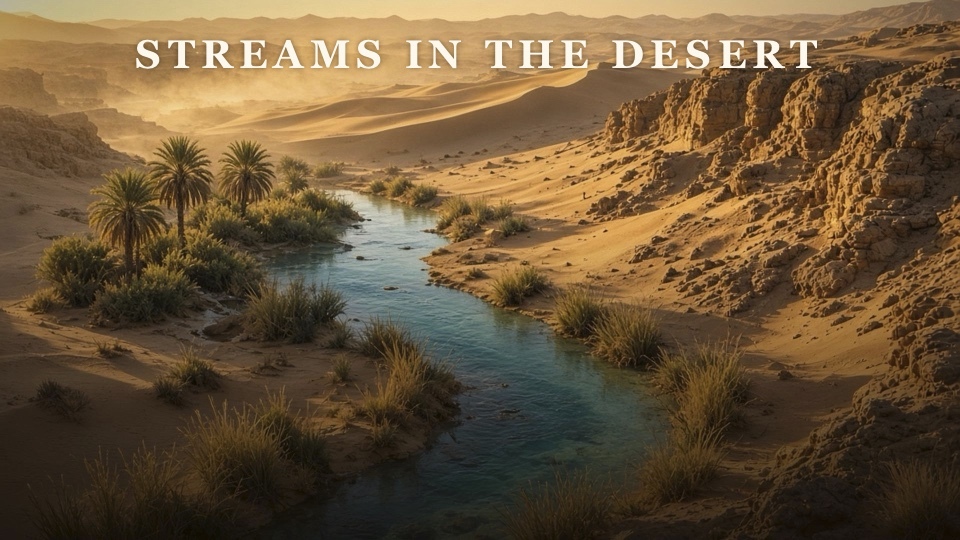
One of the most honest and freeing truths in scripture is that God rarely explains the method. He does not hand you a ten-step plan for how the desert is going to bloom or how the river is going to appear in a dry place. He simply declares that it will happen.
"Then the lame shall leap like a deer, and the tongue of the dumb sing. For waters shall burst forth in the wilderness, and streams in the desert." - Isaiah 35:6 New King James Version (NKJV)
God does not owe you an explanation of how. He asks you to believe that He will. And then He asks you to do the work in front of you, to till the ground, to pray, to show up, to keep going, even when the ground looks dry.
What Happens When You Stop Believing the Desert Is Permanent
If you agree with the enemy that your dry season is permanent, you will get exactly what you believe. But if you refuse to accept that the desert is your final destination, something shifts.
Isaiah 35:3 says:
"Strengthen the weak hands, and make firm the feeble knees." - Isaiah 35:3 New King James Version (NKJV)
And verse 4 continues:
"Say to those who are fearful-hearted, 'Be strong, do not fear! Behold, your God will come with vengeance, with the recompense of God; He will come and save you.'" - Isaiah 35:4 New King James Version (NKJV)
This is a word for the weak. For the fearful. For the ones who are not sure they can keep going. God is not speaking to the strong and confident here. He is speaking directly to the ones who feel overwhelmed.
You Are Not Fighting Alone
There is a moment in scripture where a prophet's servant panics because the enemy has surrounded the city. He runs to the prophet and says, what do we do? We are surrounded on every side.
The prophet prays a short prayer. God, open His eyes. And when the servant looked again, he did not see the armies at his feet. He saw chariots of fire surrounding the hills above the city.
The enemy was surrounded by God. The problem was surrounded by God. The fear was surrounded by God.
First Corinthians 6:19 reminds us:
"Or do you not know that your body is the temple of the Holy Spirit who is in you, whom you have from God, and you are not your own?" - 1 Corinthians 6:19 New King James Version (NKJV)
His Spirit lives inside of you. There is not an enemy that is able to defeat your God. The mountain is not bigger than the One who lives in you.
The Word of God Is Trustworthy
Critics have long claimed that certain people and places mentioned in the Bible never existed. Sennacherib was one of them. But archaeologists dug into what appeared to be an ordinary mountain and found a massive complex, a city dedicated to a people the Bible mentioned by name, in exactly the location scripture described.
The word of God is trustworthy down to individual names and individual peoples. Every promise He has made, He is able to keep. If He said there will be springs in the desert, there will be springs in the desert.
Life Application
This week, identify one area of your life where you have been agreeing with the enemy instead of trusting God. It might be a situation in your marriage, your finances, your health, or your family. Instead of rehearsing the size of the problem, take it to God the way Hezekiah took that letter into the house of the Lord. Lay it before Him. Speak to the mountain out loud. Declare that God is bigger than what surrounds you, and then do the work in front of you without waiting for God to explain how He is going to do it.
Ask yourself these questions as you reflect this week:
- Where have I been making small compromises that are opening the door to larger ones?
- Am I agreeing with the enemy about my situation, or am I agreeing with what God says about it?
- What would it look like for me to bring my biggest problem before God this week the way Hezekiah spread that letter before the Lord?
- Do I truly believe that God is bigger than what I am facing, or am I only saying it?
- What is one step of faith I can take this week, even without knowing how God is going to move?
God is not asking you to pretend the mountain is not there. He is asking you to stop letting the mountain have the last word. Speak to it. Trust the One who lives inside of you. Springs are coming to the desert.