I will Live

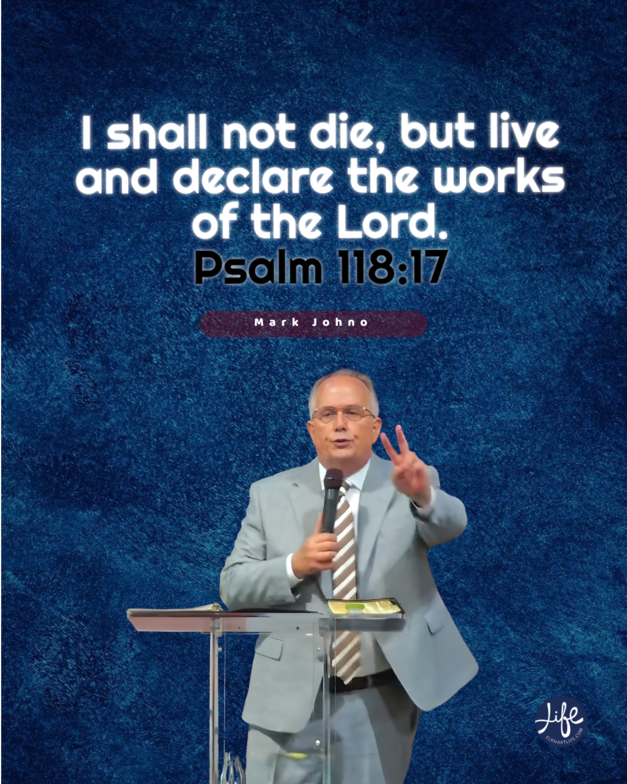
I Shall Not Die, But Live: Declaring God's Victory Over Fear and Doubt
There is a declaration found in Psalms 118:17 that carries the weight of every battle ever fought, every fear ever whispered, and every moment a person wondered if they would make it through. It is short, bold, and deeply personal: "I shall not die, but live, and declare the works of the Lord." This post unpacks what that declaration really means and why it still matters today.
What Does "I Shall Not Die, But Live" Really Mean?
Psalms 118:17 says, "I shall not die, but live, and declare the works of the Lord." (NKJV)
The only time a person makes a statement like that is when they are afraid they might not survive. David was not writing from a place of comfort. He was writing from the middle of conflict, surrounded by enemies, betrayed by people close to him, and fighting battles on every side.
This verse is not just a poetic expression. It is a declaration made against an internal enemy, the voice that creeps into your mind and says you are not going to make it out of this one.
Who Was David, and Why Did He Need to Say This?
David was a man of war. His own king, Saul, threw a spear at him more than once. Saul gathered armies to hunt him down. David's own son Absalom turned against him and tried to overthrow his kingdom. When Absalom was killed in battle, David wept so bitterly that his victorious soldiers came back from the fight with their heads bowed in shame, hearing their king cry out from an upper chamber.
David fought enemies to the south, east, west, and north. He had blood on his hands from decades of war. He even had a heart to build God a temple, and God told Him through the prophet Nathan that he could not build it because of all the blood He had shed.
Yet David's response was not bitterness. He said, fine, then I will gather everything that is needed so someone else can build it. He spent his remaining years collecting gold, silver, stone, and timber for a temple he would never see completed.
That is the kind of faith this declaration comes from.
What Can We Learn from Paul and Silas About Praising God in Hard Times?
Paul and Silas were beaten and thrown into a Philippian jail for doing something good. They had set a woman free from demonic bondage, and it cost her owners money, so they were arrested, beaten, and locked up.
At midnight, with bloody backs and no justice in sight, they were worshiping God.
Years later, Paul wrote back to the church in Philippi, the very city where all of that happened, and told them they ought to praise the Lord at all times. He was not speaking from a comfortable life. He had been beaten repeatedly, shipwrecked, stoned, and imprisoned more times than he could count. His instruction to praise God came from lived experience, not theory.
The mindset Paul and David both carried was this: the circumstances I am in must bow to the God I serve. I will not bow to the circumstances.
Why Does the Enemy Tell You the Truth Sometimes?
King Hezekiah received a letter from Sennacherib, the Assyrian king, that was full of facts. Sennacherib told him he would give him 600 horses if he could find enough men to ride them. He listed city after city that his armies had already defeated. He pointed out that none of their gods had been able to stop Him.
And he was right. Hezekiah did not have enough men. He could not match the Assyrian army. The facts were accurate.
But the conclusion was a lie. The conclusion was: you are not going to make it out of this.
The enemy often wraps truth in a lie. He tells you what is real about your situation and then attaches a false ending. Your finances are a mess. True. You will never recover. That is the lie.
What Did Hezekiah Do That We Should Do Too?
Hezekiah took the letter into the temple and laid it on the altar before God. He spread it out and essentially said, "Do you see what they wrote? Do you see what they said about You?"
He was not pretending the problem did not exist. He was acknowledging that the battle was not his to fight alone. He brought it to God and stepped back.
That is the key. You may not be able to heal yourself. You may not be able to fix your finances, repair your relationships, or solve the crisis in front of you. But you can take it to God and say, this is not my problem anymore. I am laying it on Your altar.
The problem does not disappear the moment you do that. But it is no longer yours to carry alone. And when it is no longer yours to carry, you can worship with a clean heart and a right Spirit.
How Does the Great Wall of China Illustrate Spiritual Warfare?
The Great Wall of China stretches for hundreds of miles and has never been breached from the outside. No army has knocked it down. No battering ram has broken through it.
But China was invaded three times through the wall. Each time, a guard at the gate took a bribe and opened the door from the inside.
The greatest threat to your faith is not always the enemy outside. It is the voice inside that agrees with him. When you adopt a mindset of defeat, when you rehearse every reason things will not work out, you are opening the gate yourself.
David's declaration, "I shall not die, but live," was not just about the armies surrounding him. It was a statement made against the enemy within. It matters what you say to yourself.
What Happens When You Agree with the Devil?
Agreeing with the enemy's conclusion is like handing over the keys to your city. It is like walking up to Sennacherib and saying, you are right, here is the gate, help yourself.
A negative, defeated mindset does not just affect your mood. It affects your ability to worship, to trust, and to receive from God. If you are shaking hands with the devil's conclusion, you have already decided the outcome before God has had a chance to move.
The mind can lock you in a cage of fear, bitterness, and hurt. And as long as you hold on to all of that, praise becomes nearly impossible. But when you lay it on the altar, something shifts. You still have the problem, but it is no longer yours to solve alone.
What Does It Mean That God Anointed David "From That Day On"?
1 Samuel 16:13 says, "Then Samuel took the horn of oil and anointed him in the midst of his brothers; and the Spirit of the Lord came upon David from that day forward." (NKJV)
From that day forward. Not just on the good days. Not just when David had it together. The Spirit of the Lord came upon Him and stayed through 20 years of running, hiding, and fighting before He ever became king, and then through 40 more years of battles and heartbreak after that.
God said, I am going with you. And He never left.
If you have been filled with the Holy Spirit and baptized in Jesus' name, that same declaration applies to you. God is still there. He has not left. He is still going with you through whatever you are facing right now.
How Can You Praise God When Everything Is Going Wrong?
The answer is not to pretend everything is fine. David did not pretend. Paul did not pretend. Hezekiah did not pretend.
The answer is to make a decision that God is in charge of tomorrow, not your circumstances. Your past does not have to write your future. God can turn your yesterdays to ash and give you a brand new tomorrow. His hand is for you, not against you.
Praise is not a feeling. It is a choice made in the middle of the storm. It is saying, I will magnify the Lord at all times, because the enemy does not write my future. The Almighty God does.
Life Application
This week, identify one specific fear, problem, or burden you have been carrying and agreeing with. Write it down if you need to. Then, like Hezekiah, bring it before God and lay it on the altar. Say out loud, "This is not mine to carry. God, I am giving this to You."
Then make a deliberate choice to praise Him anyway, not because the problem is gone, but because He is greater than the problem.
Ask yourself these questions as you reflect on this message:
- What conclusions have I been agreeing with that the enemy has attached to true circumstances in my life?
- Am I guarding the gate of my mind, or have I been letting fear and doubt open the door from the inside?
- When did God first show up in my life, and do I still trust that He has not left?
- What would it look like for me to praise God this week, not because things are easy, but because He is faithful?
You shall not die, but live, and declare the works of the Lord. That is not just a verse. It is a declaration you can make today, no matter what you are facing.